
How Much Should You Feed Your Dog? A Practical Guide
There is no single number that fits every dog. The right amount depends on your dog’s size, age, energy level, health, and the food you feed.
The best approach is to start with the feeding guide on your dog’s food, measure portions accurately, and then adjust based on your dog’s body condition. This guide shows you how, and when to bring your veterinarian in.
The Short Answer
- Start with the feeding guide on your dog’s food. Treat it as a starting point, not a prescription.
- Measure every meal. Don’t eyeball it.
- Check your dog’s body condition every few weeks. You should be able to feel the ribs and see a waist.
- Adjust gradually up or down based on what you see.
- Count treats as part of the daily total.
- Ask your vet for a calorie target if your dog is a puppy, a senior, overweight, underweight, or has a health condition.
Why There Is No One-Size-Fits-All Amount
Two dogs of the same weight can need very different amounts of food. How much to feed depends on size, age, energy level, health issues and the type of food.
| Factor | How it affects portions |
|---|---|
| Age | Puppies are growing and need more calories, along with higher levels of protein and other nutrients, than older dogs. Older dogs typically need fewer calories to maintain a healthy weight. |
| Activity level | Active dogs use more energy than sedentary dogs. |
| Environment | Dogs that spend time outdoors in severe cold burn more calories to stay warm. The American Kennel Club notes that these dogs can use anywhere from 10% to 90% more energy than other dogs. |
| Health | Medical conditions can change both how much and how often a dog should eat. |
| Type of food | Foods differ in calorie density, so the same scoop of two different foods can supply very different amounts of energy. |
Step 1: Start With the Feeding Guide on Your Dog’s Food
Most dog foods print feeding amounts by body weight on the bag or can. Use these as your starting point.
The American Kennel Club advises treating this information as a suggestion rather than a requirement, because the guidelines can sometimes result in larger portions than a dog needs. Your dog’s real needs may be higher or lower.
A few practical points:
- Use the right food for the life stage. A food made for puppies has a different feeding guide than one made for adults.
- Weigh your dog before you start, then recheck regularly.
- Check the units. Labels differ between brands and countries. Some use cups, some use grams, and calories are listed in different ways. Follow the units on your bag.
- Divide the daily amount into meals. The chart gives a total for 24 hours, not per meal.
Step 2: Measure Accurately
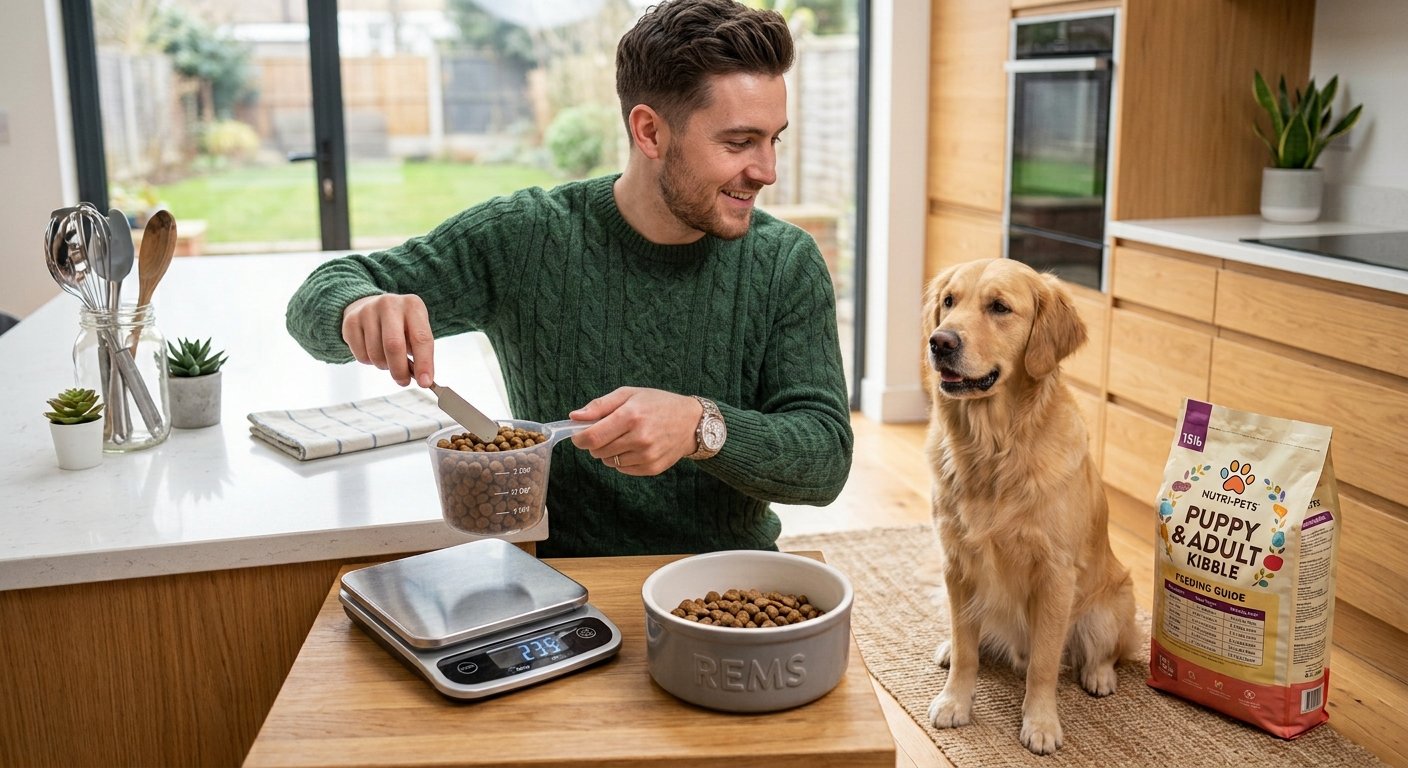
A scoop can be packed tightly or filled loosely, so the same “cup” can hold quite different amounts of food. A kitchen scale or a dedicated pet-food scale gives you more consistent portions. A level measuring scoop is the next best option.
This matters most for small dogs, where a few extra kibbles per meal can add up. It also matters for dogs that gain weight easily.
Step 3: Check Your Dog’s Body Condition
The scale is useful, but your dog’s body shape tells you more. Veterinarians use a body condition score (BCS), usually on a 9-point scale, to judge whether a dog is carrying too little, too much, or a healthy amount of body fat. According to the University of Guelph’s Ontario Veterinary College, a score of 4 or 5 out of 9 is ideal, and each point above 5 represents an additional 10 to 15 percent body fat.
You can do a simple check at home:
- Ribs: You should be able to feel them easily under a light layer of fat, without pressing hard. They shouldn’t be sharply visible.
- Waist: Looking down at your dog from above, you should see a waist behind the ribs.
- Belly: From the side, the belly should tuck up toward the back legs.
Signs your dog may be getting too much: the ribs are hard to feel, the waist has disappeared, or the belly looks rounded.
Signs your dog may be getting too little: the ribs, spine or hip bones are clearly visible.
If you’re unsure what you’re seeing, ask your vet to score your dog and show you what to look for. Do this at your dog’s next visit.
Step 4: Adjust Slowly and Recheck
If your dog is gaining or losing weight, or the body check shows a problem, adjust the portion a little and recheck in a few weeks. Avoid big, sudden changes.
If your dog is clearly overweight or underweight, ask your vet to set a target weight and a feeding plan. Cutting portions too far without guidance can leave a dog short of essential nutrients, and an unexplained weight change can also be a sign of a health problem.
How Often Should You Feed Your Dog?
| Life stage | Typical approach |
|---|---|
| Puppies | Three to four smaller meals a day can suit a puppy’s small stomach |
| Adult dogs | Most vets recommend at least two meals a day; some dogs that are less food-motivated do fine with one |
| Senior dogs | Ask your vet. Needs vary with health and appetite |
Feeding at regular times also gives dogs a predictable routine. VCA Animal Hospitals notes that a dog living alone with an owner can sometimes be allowed to graze, as long as the day’s portion is measured out. But many owners find measured meals easier because they can see exactly how much their dog eats and notice changes in appetite quickly.
Don’t Forget Treats and Extras
Treats, chews, training rewards and table scraps all contain calories. The common guideline from veterinary sources is that treats and extras should make up no more than 10% of a dog’s daily calories, with at least 90% coming from a complete and balanced food.
UC Davis’s veterinary nutrition team gives a simple example. If a dog eats 100 calories a day, no more than 10 of those calories should come from treats or other foods.
Some ways to stay within budget:
- Know your dog’s daily calories, ideally from your vet, then take 10% of that number.
- Check treat labels for calories per treat.
- Use part of the daily kibble as training rewards.
- Cut back the meal a little if you’ve given extra treats that day.
If your dog is on a special veterinary diet, ask your vet before adding treats. Some prescription diets may not work properly if extra foods are added.
Common Feeding Mistakes
- Following the bag exactly without checking the dog. The label is an average, not your dog.
- Using a scoop without leveling it. Small errors repeat twice a day, every day.
- Forgetting treats. They count toward the daily total.
- Using an adult chart for a puppy, or a puppy food for an adult dog.
- Feeding to match a “healthy-looking” weight someone else mentioned. Your vet and body condition check are better guides.
- Changing portions often. Make a small change and give it a few weeks.
- Ignoring changes in appetite. A dog that suddenly eats much less or more, or loses or gains weight without a diet change, should be seen by a vet.
When to Ask Your Veterinarian
Talk to your vet about feeding amounts if your dog:
- Is a puppy, a senior, pregnant or nursing
- Is overweight, underweight, or changing weight without a diet change
- Has a medical condition, such as digestive, kidney, heart or allergy problems
- Eats a prescription or special diet
- Has a very high or very low activity level
- Is losing interest in food or begging constantly
Your vet can calculate a daily calorie target based on your dog’s lifestyle and body condition score.
Helpful Products for Portion Control
If you choose to link to products, add a clear affiliate disclosure near the top of the post, for example: “This article contains affiliate links. If you buy through them, DogCare Daily may earn a commission at no extra cost to you.” Check the disclosure rules that apply in your country.
These product types can make accurate feeding easier:
- Digital kitchen or pet-food scales. They give more consistent portions than a scoop.
- Measuring scoops with level markings. A simple option if you prefer cups.
- Airtight food storage containers. They keep food in one place and make it easy to measure straight from the container.
- Slow-feeder bowls or puzzle feeders. Some owners use them for dogs that eat very quickly. They change how a dog eats, not how much it needs.
Choose products based on your dog’s size and habits, and check them against your own needs rather than ratings alone.
Frequently Asked Questions
How many cups of food should I feed my dog?
It depends on the food and your dog. Cups of one food can hold very different calories from another, so there is no universal number. Start with the guide on your dog’s food, then adjust using your dog’s body condition and your vet’s advice.
Should I feed my dog the amount on the bag?
Use it as a starting point. The American Kennel Club advises treating the guide as a suggestion, since it can lead to larger portions than some dogs need.
How do I know if I’m overfeeding my dog?
Look at your dog’s shape. If you can’t easily feel the ribs, the waist has disappeared, or the belly looks rounded, your dog may be getting too many calories. Ask your vet for a target weight and feeding plan.
How many times a day should I feed my dog?
Adult dogs are usually fed at least two meals a day, while puppies often do better with three to four smaller meals. Some adult dogs do well on one meal a day. Ask your vet what suits your dog.
Do treats count toward my dog’s daily food?
Yes. Treats, chews and table scraps should be no more than about 10% of daily calories, with the rest from a complete and balanced diet.
Do senior dogs need less food?
Older dogs typically need fewer calories to maintain a healthy weight, but individual needs vary. Appetite changes or weight loss in an older dog should be checked by a vet rather than assumed to be normal aging.
Conclusion
The right amount of food for your dog is one you find by measuring, watching and adjusting. Start with the feeding guide on the food, measure accurately, check your dog’s body condition, and count treats as part of the daily total. When something doesn’t look right, or your dog’s age or health makes things more complicated, your veterinarian can give you a calorie target that fits your dog.
Veterinary and Nutrition References
- American Kennel Club, “How Much Should I Feed My Dog?”: https://www.akc.org/expert-advice/nutrition/how-much-should-i-feed-my-dog/
- VCA Animal Hospitals, “Feeding Times and Frequency for Your Dog”: https://vcahospitals.com/know-your-pet/feeding-times-and-frequency-for-your-dog
- VCA Animal Hospitals, “Dog Treats”: https://vcahospitals.com/know-your-pet/pet-health-articles/dog-treats
- UC Davis School of Veterinary Medicine, “Treat Guidelines for Dogs”: https://healthtopics.vetmed.ucdavis.edu/node/916
- University of Guelph, Ontario Veterinary College Pet Nutrition, “Scoring for Health”: https://ovcpetnutrition.uoguelph.ca/2021/10/25/scoring-for-health
- WSAVA body condition score chart for dogs and cats (PDF hosted by The Ohio State University Veterinary Medical Center): https://vmc.vet.osu.edu/sites/default/files/documents/wsava-bcs-chart-dogs-cats.pdf
This article is for general information and does not replace advice from your veterinarian.