

Health Extensions Dog Food: Ingredients, Benefits, and Nutrition Explained
Health Extension dog food offers several food formats, so your first choice is how you want to feed and store your dog’s meals. Which format fits your home best? Your answer affects moisture, calories, and the daily work of feeding. The main options are dry food, gently cooked food, wet food, and air-dried food.
A nutritional adequacy statement is a label declaration that a food is complete and balanced for a specified life stage or is intended only as a supplement. It helps you tell a full meal from a topper. Life stage matters because puppies, adults, and senior dogs can have different needs. Your dog’s tastes and your feeding routine matter, too.
Key Takeaways
- Choose among dry, gently cooked, wet, and air-dried food.
- Check the nutritional adequacy statement and life-stage fit.
- Compare calories and moisture when considering meal formats.
- Match the food to your dog’s needs and your daily routine.
- Use veterinary guidance for health concerns or special diets.
Start by matching the format to your daily routine, then check that the recipe’s life-stage statement fits your dog.
Which Health Extension food format fits your routine?
Dry food is the straightforward scoop-and-serve option, while the other formats offer different textures, moisture, and storage routines. Storage needs vary, but the package’s nutritional adequacy statement determines whether a recipe suits your dog’s life stage.
The lineup includes grain-inclusive and grain-free choices, plus foods with different meal roles. Read the package to learn whether a recipe is a full diet or a supplement.
Use a recipe as your dog’s sole diet only when its nutritional adequacy statement supports that use.
Dry kibble for an everyday base
Dry kibble gives you a simple scoop-and-serve routine. Core dry recipes start with real meat and include more than 30 superfoods and probiotics.
Health Extension makes its core dry dog food in the United States without corn, wheat, soy, artificial flavors, colors, or preservatives. Grain-inclusive choices include Original Chicken & Brown Rice and Lamb & Brown Rice.
Grain-free recipes are also available, along with Little Bites for smaller mouths and Large Bites. The grain-inclusive and grain-free options let you choose a recipe style that suits your preferences.
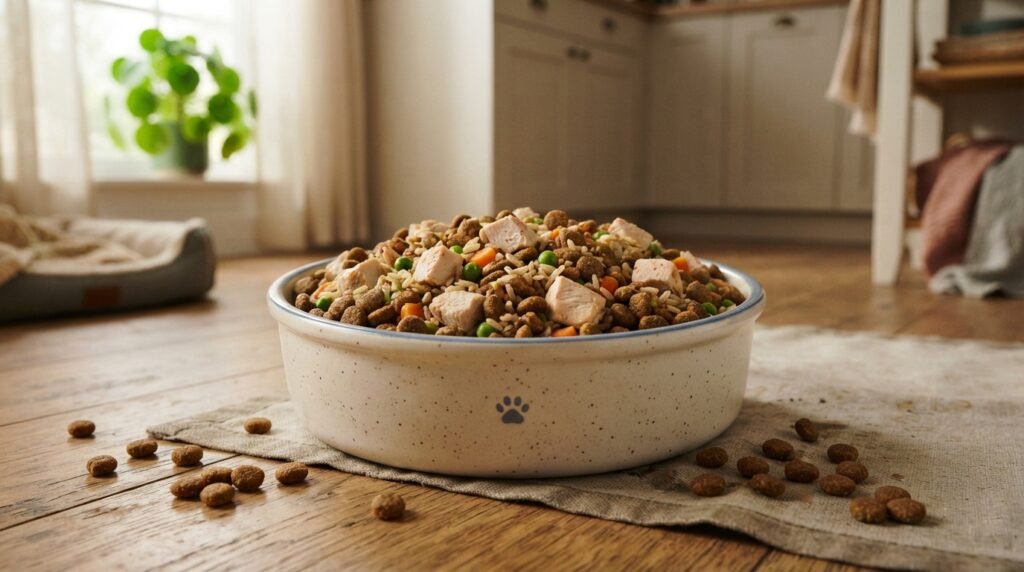
Gently cooked, wet, and air-dried options
Gently cooked food, wet food, and air-dried food differ in texture, use, and storage. The table compares their typical roles and stated life-stage fit.
| Format | Typical use | Storage | Life-stage fit |
|---|---|---|---|
| Dry | Daily meal or mixed meal | Keep bag sealed as directed | Check recipe statement |
| Gently cooked | Meal or mixed meal | Shelf-stable pouch; no thawing | Most core recipes: all life stages, including large-dog growth |
| Wet | Meal or supplemental mixer | Cover and refrigerate opened leftovers | Depends on complete or supplemental label |
| Air-dried | Meal, topper, or treat | Shelf-stable bag | All life stages except large-dog growth |
Core gently cooked recipes include Chicken & Pumpkin, Beef & Potato, Lamb & Carrot, Duck & Kale, and Salmon. They meet AAFCO Dog Food Nutrient Profiles for all life stages, including growth of large-size dogs. The large-dog growth claim is distinct from the vegetarian recipe, which is for adult maintenance.
These shelf-stable gently cooked meals come in pouches and need no refrigeration or thawing before opening. Wet choices include grain-inclusive and grain-free entrees, 95% meat recipes, stews, and Little Cups.
Wet food labeled complete and balanced can serve as a full meal. Supplemental wet recipes are mixers only; cover and refrigerate opened leftovers for the period stated on the can or cup.
Air-dried Chicken, Beef, and Salmon come in 12-ounce and 2-pound bags. The brand describes these recipes as 100% human-grade, with 85% of protein from animal sources and more than 30 superfoods.
Air-dried recipes meet AAFCO profiles for all life stages except growth of large-size dogs, defined as 70 pounds or more as adults. Check the package’s nutritional adequacy statement before using any format as your dog’s sole diet.
How Good Is Health Extensions Dog Food for Your Dog?
A long ingredient list shows what a recipe contains. It cannot establish ingredient quality or prove the food suits your dog. Look beyond the list: nutritional adequacy and life-stage fit matter more than a single ingredient claim.
Ingredient lists alone do not show ingredient quality, and they can give a misleading picture of a food’s overall value. A recipe’s name or ingredient order cannot tell you everything about its nutrition.
What ingredient lists can and cannot tell you
Health Extension names apple cider vinegar, ginger, coconut oil, colostrum, and turmeric as examples of superfoods. Those ingredients may interest you, but their presence does not prove a recipe is nutritionally better.
The company says its products go through testing with more than 140 total checkpoints. That testing claim is separate from proof that a recipe meets your dog’s needs.
Searches for Health Extension dog food ingredients often focus on individual items, such as chicken brown rice. A recipe’s ingredients are useful for spotting known sensitivities, but they do not establish quality by themselves.
How to assess life-stage nutrition
Start with the recipe’s nutritional adequacy statement, then check whether its life-stage claim fits your dog. This label tells you whether the food is complete and balanced for a stated stage or meant only as a supplement.
Health Extension dog food reviews can add context, but they cannot replace label checks or your dog’s own needs. Dog Food Advisor rates its grain-inclusive dry food 4.5 stars and calls it highly recommended.
Dog Food Advisor also rates both grain-inclusive and grain-free canned foods 4.5 stars, calling them highly recommended. These ratings are one point to consider, not a guarantee for every dog or recipe. The published rating excerpts do not assess your dog’s individual health.
What makes a dog food the healthiest choice?
The healthiest dog food for your pet is a complete-and-balanced recipe suited to its life stage and individual needs. No recipe should be treated as a universal healing food or a cure for disease.
Use these four checks when you assess a recipe:
- Read the nutritional adequacy statement.
- Confirm the stated life stage fits your dog.
- Scan the full ingredient list for known sensitivities.
- Watch your dog’s response, with veterinary guidance when needed.
Your dog’s response may include changes in appetite or other signs that concern you. Keep track of those changes and discuss them with a veterinarian when they persist.
For practical information on nutrition and well-being, explore DogCare Daily’s dog-care resources. Ask your veterinarian to help assess a diet when your dog has a diagnosed condition or a persistent reaction to food.
How do you choose a recipe and find a retailer?
For a small dog with a small mouth, Little Bites is a clear starting point. It is Health Extension’s small-kibble line. Then compare life stage, protein, and grain preference before choosing a recipe.
Count calories from every food in a mixed meal, not just the kibble. The bag’s feeding guide can help you set a starting portion for your dog.
Match the recipe to your dog
Little Bites is dry food with small kibble for teacup, toy, and small-breed dogs. It comes in grain-inclusive and grain-free recipes.
Choose a protein your dog eats well, such as chicken or salmon, and check the recipe’s life-stage statement. Little Bites Lite has about 50% less fat than regular Little Bites Chicken & Brown Rice. Discuss it as a weight-conscious feeding option, not a treatment.
Dry recipes can be served alone or mixed with wet food or gently cooked food. Use these steps to plan portions and introduce a new dry recipe:
- Compare the bag’s feeding guide with your dog’s needs.
- Introduce the new food over about 7 to 10 days, gradually increasing its share.
- Adjust portions using total calories from mixed foods.

Check sizes, prices, and buying options
Little Bites Chicken & Brown Rice comes in 1-pound, 4-pound, 10-pound, 18-pound, and 30-pound bags. The listed price for the 1-pound bag is $6.99 for that size.
Grain Free Salmon & Sweet Potato is listed at $28.98 for a 4-pound bag. Product pages display customer ratings of 4.8926654/5 from 559 reviews for Little Bites Chicken & Brown Rice.
Original Chicken & Brown Rice shows 4.899371/5 from 159 reviews. Grain Free Salmon & Sweet Potato shows 4.892857/5 from 84 reviews. These are customer ratings, not guarantees of food quality or fit.
The store locator links to Amazon and Chewy. To find Health Extension dog food near me, use its locator and retailer options, but a link does not confirm local stock.
SNAP benefits cannot pay for pet food. Check the current product listing and package label before ordering, since the listed price and the recipe’s feeding directions apply to specific sizes and formulas.
What alternatives are similar to Health Extension?
The closest alternative depends first on whether you want fresh meals or kibble. These brands have different formats and positioning, so compare the recipe, not just the name.
The Farmer’s Dog is the closest format match for refrigerated or frozen fresh dog food. Open Farm, Orijen, and Purina Pro Plan are kibble comparisons with different approaches.
Compare each specific recipe for life-stage fit and feeding format before treating brands as direct substitutes.
A shared format does not make two recipes equal; check each recipe’s life-stage statement and intended use.
| Brand | Format or positioning | What to compare |
|---|---|---|
| Health Extension | Dry, wet, gently cooked, air-dried | Recipe format and life-stage fit |
| The Farmer’s Dog | Refrigerated or frozen fresh-food subscription | Fresh meal routine and storage needs |
| Open Farm | Premium ethical kibble | Ingredient details and kibble fit |
| Orijen | Ultra-high-protein kibble | Protein focus and feeding experience |
| Purina Pro Plan | Widely available mainstream kibble | Availability, recipe, and value |
Fresh meals require a different routine from dry food. Consider whether refrigeration or freezing fits your space and feeding habits before comparing recipes.
For kibble, compare each recipe’s ingredient details and protein focus. A premium or high-protein label alone does not tell you whether a food suits your dog.
Use five checks to compare brands: ingredient quality and transparency; nutritional completeness and life-stage fit; format fit; digestibility and feeding experience; and price transparency and value.
Price transparency matters because the listed price only makes sense alongside package size and feeding directions. Your dog’s life stage still needs to match the recipe, even when two foods seem similar.
Compare the specific recipe’s life-stage statement and feeding format before treating two brands as equivalents.
Conclusion
A good shortlist starts with the format you can feed consistently and a recipe labeled for your dog’s life stage. The right nutrition also needs to suit your dog’s needs and your household routine.
Take one concrete step: read the label on the recipe you are considering, then compare its feeding guide with your dog’s current routine. A steady routine can make portions easier to manage and changes easier to notice. DogCare Daily offers more practical dog-care information as you make informed choices. Before placing an order, confirm the exact recipe and package size you intend to feed.